by Sandra Scott
When vacationers think of a Caribbean getaway, Cartagena, Colombia, is not usually at the top of their list of possible destinations but it will be before long. Cartagena offers a wonderful blend of sun, sand, sea, and history. It is currently being discovered, or rediscovered, by Europeans and the cruise crowd.
Located at the tip of El Laguito Peninsula in calm Cartagena Bay the Hilton is the best accommodation choice in Cartagena. The Hilton has multiple pools and beaches on three sides making it the perfect place to experience the sun, sand, and sea. Plus it is only a short taxi ride to Old Cartegena and the area’s other attractions.
Cartagena has a long, and often violent, history starting with the arrival of Don Pedro de Heredia who founded Cartagena de Indias for the Spanish in 1533.
When gold, emeralds, and other riches were discovered, Cartagena became the port through which the booty was sent to Spain. To protect the riches from buccaneers and pirates, impressive fortifications were built. Most of Cartagena is still surrounded a coral wall seven miles long, 40-foot high wall, and in some places it is 60 feet wide.
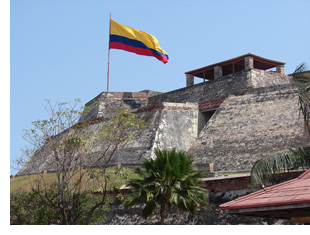 After numerous attacks by pirates, including Sir Francis Drake and an English force that included Lawrence Washington, George Washington’s half-brother, the Fortress San Felipe de Barajas was built.
Standing more than 130 feet tall, it has a series of galleries and tunnels so linked that if a section of the fort is overcome defenders can continue fighting from the remaining sections. The building of the fortification necessitated the need for labor so slaves were imported, in part because war and disease had decimated the indigenous Carib population.
The old walled city of Cartagena is a World Heritage Site and a living museum. Just past the Puerta del Roloj, the Clock Tower, is the Plaza de los Coches, where the slaves were traded.
Today it is a picturesque square with street vendors and horse drawn carriages making it hard to imagine the angst and suffering that took place there nearly 500 years ago.
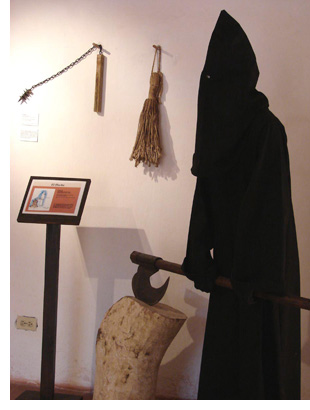
Even more hard to comprehend are the displays of instruments of torture at the El Palacio de la Inquisicion. Today all is serene. The Las Bovedas, the dungeons, a series of cells built in the old city walls have been converted into shops where local artisans sell their goods.
Beware of street vendors selling “real” emerald and offering “a special deal just for you!” If buying emeralds in on the agenda go to one of the ubiquitous emerald stores or manufacturing sites to learn how to judge the quality and value before making a purchase.
The Cathedral de San Pedro Claver was named for the Spanish Jesuit who baptized hundreds of thousands of African slaves, which was all part of a vision he had as a young boy in Spain. A beautiful stained-glass window, a series of paintings depicting his life, and a bronze statue outside in the plaza celebrate his life.
 The entire old city of Cartagena is a living museum with the 16th and 17th century Spanish architecture well preserved or restored. Hours can be spent wandering the narrow cobbled lanes, visiting the churches, relaxing in the plazas, and admiring the overhanging balconies laden with flowers.
For a spectacular view of the city and harbor head to Convento de la Popa, on a hill nearly 500 feet above the city.
Sometimes known as Goat’s Leap, it was once the site of worship by the indigenous people, and legend has it that their symbolic solid gold goat was thrown off the precipice by missionaries making one wonder if it is still in the waters below.
The sea holds many treasures. One of the richest wrecks of the Spanish Main is the on the San Jose, which sank 300 years ago carrying 116 chest of emeralds, 30 million pieces of gold, plus silver and other riches thought to be worth three billion dollars.
Between sporadic periods of fighting, life settled down and some people enjoyed the “good life” as is evidenced by the beautiful homes is the historic section of Cartagena call Manga. Many homes exhibit features of Moorish architectural and have been with their bright colors glowing in the sun.
While hours can be spent wandering the city and just sitting watching life pass by there are great side trips. The most popular is a day trip to Rosario Islands, an hour by boat, where the water and beaches are spectacular with dolphin shows, and all manner of water activities.
Or head to nature’s biggest mud spa, Totumo Volcano, to soak in the warm mud. For nighttime excitement take a Chiva Tour, which is basically a party bus with live music and libations.
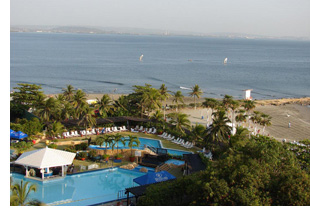 The best part of the day excursions is returning to the Hilton, a place where they always know your name! The staff has an amazing ability to call quests by their name.
With three pools, tennis courts, and beaches, the Hilton is the perfect place to kick back. Order room service, sit on the balcony, and enjoy the view.
Shuttle boats crisscross the bay, huge cruise ships pass by, frigate birds and pelicans glide above the water in search of food, and in the evening the lights on the rise of land across the bay twinkle as do the stars above. There is always something to see from the balcony.
The hotel is a popular destination for corporate groups. From the room’s balcony we watched the staff set up dinner for hundreds – always elegant even if it is on the beach. Some events had live music so non-invited guests are privy to a free musical show – albeit from their balcony.
In the morning it’s time to start another day of fun in the sun in Cartagena.
About the author:
Travel Editor Vic Foster’s guest this week is veteran travel writer/photographer Sandra Scott, who lives near Lake Ontario in upstate New York.
Photos by Sandra Scott:
1: The Fortress San Felipe de Barajas..
2: A gruesome exhibit at the Museum in the Palacio de la Inquisicion.
3: A splendid view of Cartegena from one of the balconies of the Hilton.
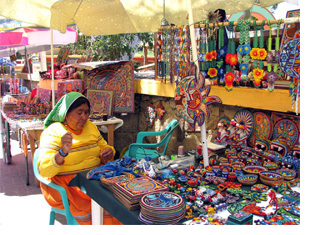
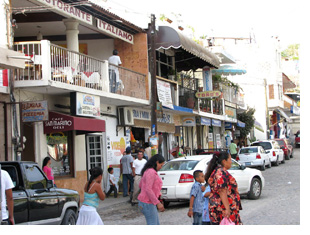 The next day’s excursion brings us to the quintessential Mexican village of Bucerias. Shop owners give their best spiel as we pass by on the cobblestone streets. I purchase several pieces of intricately beaded native Huichol art in the open air market.
 Our village hopping ends in San Francisco (also known as San Poncho). Well stocked with snacks from a local vendor of tart tamarind candy and jackfruit (tastes like a cross between banana and cantaloupe) we head for the beach. Between dense jungle and the turquoise sea we spread our mats on a patch of creamy sand.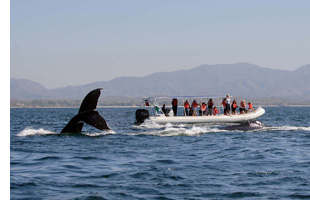
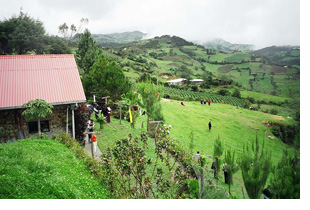 After six hours of snaking up, down, and through the Andes in our daughter’s 4-wheel drive Toyota, we finally arrive at the Blue Poncho Lodge in Cadmalca.
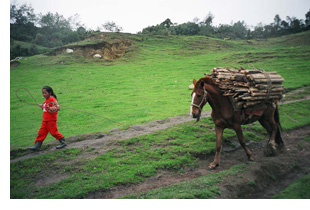 The sun warms our backs as we cross potato fields and cow pastures with our basins, shovels, buckets, and a screen for sifting sand. Our guides use horses to carry the bags of cement and bricks. One guide assists each couple.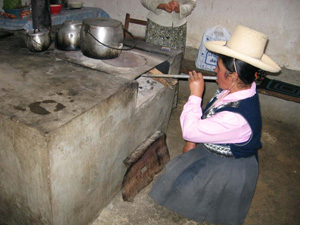
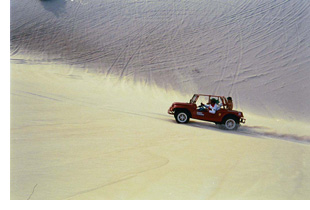
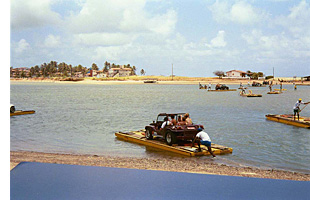 We arrived at the Potengi River, where a couple dozen other dune buggies queued up to board a ferry. While we waited, we took pictures and bought bottled water. Hawkers sold sunglasses, sunscreen, and floppy hats – all absolute necessities, as Natal lies only 5 degrees south of the Equator.
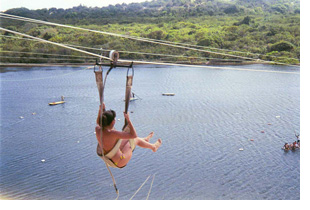 Around the periphery of a small freshwater lake, plastic tables and chairs were placed in the shallows, shaded by thatched sun umbrellas. Around to the right, a tower had been erected which the more adventurous could scale for a ride down the aero bunda (literally, “air butt”), a zip line which dumps riders off in the lake. Miguel and I had to give it a go, and took our turns getting unceremoniously dunked.
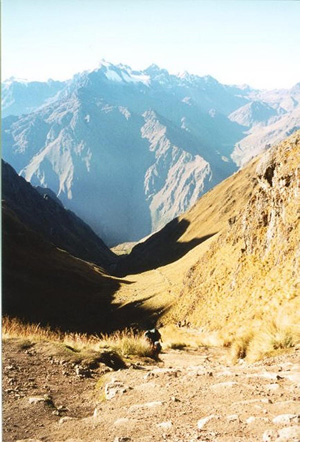 It’s four-thirty in the morning of day five. The porters have just come to our tent to wake us. No coffee or tea this morning. We need to get moving to reach the Sun Gate (Intipunku) by 7:00 a.m. or we will miss sunrise over Machu Picchu.
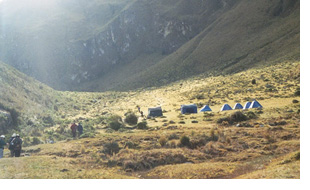 After hiking ten miles, we camped at 12,600 feet. A combination of dehydration and temperatures dropping into the twenties gave everyone a restless night of sleep.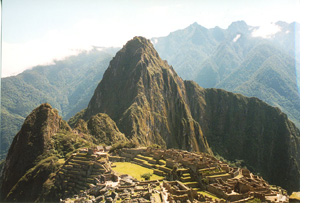
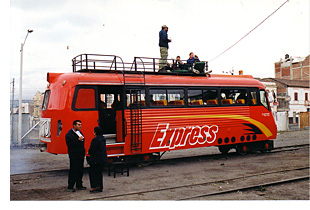
 It includes the Devil’s Nose, a sheer serrated wall of rock. The track at this point is a series of sharp zig-zags carved into rock. I never did recognize the nose of the devil here, but it looks a fiendish place to build a railway.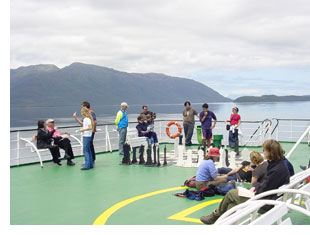
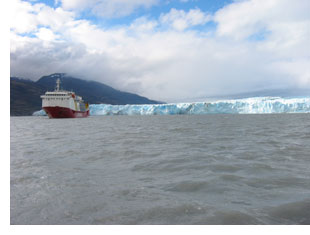 The next morning, after we inch through Paso White, the narrowest part in the trip at 80 meters, the mountains close in on both sides and we experience isolation far greater than anything we have ever felt on British Columbia’s coast. No planes, no boats, no settlements, no fish farms, no clear cuts, instead only rivers, a milky sea and glaciers from continental ice fields nestling into the Andes Cordillera.
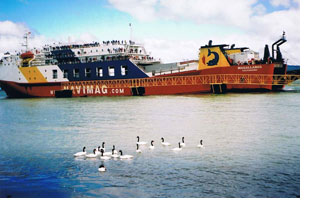 The exodus continues between courses, one couple retreats after spilling the soup course on their laps, two others battle out midway through the special Chilean dish. By dessert the boat has turned and only three of us remain. We say yes to more wine as the contents of the table clink and careen. I am jubilant with wine and victory.
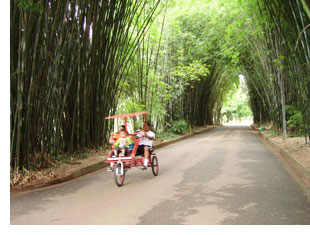 One way to learn about the character of a city is to visit a park. A visit to Ibirapuera Park, Sao Paulo’s Central Park, will exemplify the drive that makes Sao Paulo the country’s business capital. Paulistas are walking, running, riding their bikes with the same determination they take to the office. It also points out the cultural side of Sao Paulo as it is home to the Museum of Contemporary Art and Museum of Modern Art. Concerts in the park are common.
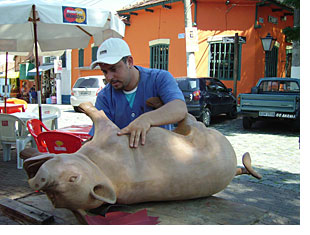 The folkloric district of Embu das Artes, thirty minutes from the center of the Sao Paulo, is a quiet step into the past with the colorful building featuring arts and crafts shops. The floor boards of the old church creak as visitors check the antique religious artworks. The old manual portable organ used for processions is especially interesting.
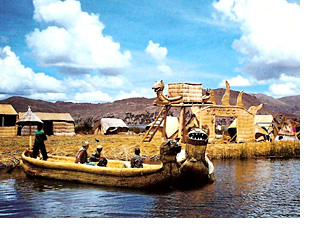 Lake Titicaca is a name all school kids know and giggle at, although most have no idea where it is – straddling as it does the border of Peru and Bolivia. Coming over a rise, our first view of its sapphire waters is stunning—170 km in length, it looks more like an ocean than a lake. Having travelled through Peru for three weeks in November and December, my husband Rick and I decide on spending the Christmas season here.
 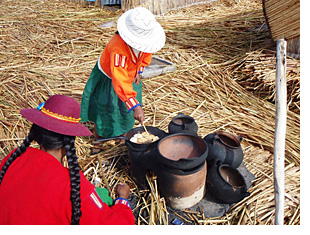 Juan explains the “why” of this water-world: “The Uros people took refuge here to escape Inca domination, and later to avoid Spanish slave labour in silver mines.”
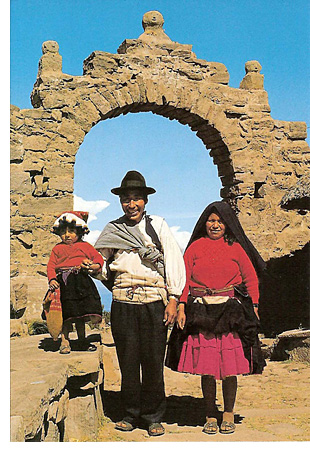 After wishing our family back home in Canada “Feliz Navidad” by phone, we walk to a small colonial church for Christmas Eve mass. We didn’t need to understand the language to be uplifted by the choir and the brightly decorated altar.