by Margaret Deefholts
He has piercing grey eyes, a strong hawk-nosed profile and a trim beard.
Dressed in dishdashah robes, and wearing a traditional chequered head scarf, (shumag), banded in place with a coiled ogal, he sits astride an Arab stallion, looking for all the world like a bit-actor in Hollywood’s Lawrence of Arabia.
The mountain that is T.E. Lawrence’s inspiration for the title of his Seven Pillars of Wisdom serves as a perfect backdrop.
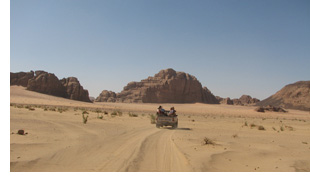 I’m at the Wadi Rum Visitors’ Centre in Jordan, and the horseman, oblivious to my goggling, is chatting to our bus driver.
A small group of us are about to board three jeeps each driven by Bedouins, (the only ones qualified to navigate the trackless desert), and take off in a convoy through the Wadi Rum which Lawrence once described as “vast, echoing and God-like”.
I’d imagined the desert as a swell of sand dunes stretching endlessly to a distant horizon, but the Wadi Rum is a wilderness of a different sort.
Stunted bushes pock-mark the sandy soil, and gigantic monolithic crags rear up against the sky, their surfaces worn by time and weather into fantastical shapes. Some appear crumbly as insect-bored wood; others are wind-sculpted into clenched fists, or crenellated bastions.
The colours shift from dun to ochre, and in the distance, the rocks fade to a pale grey. The sun brazens down from a metallic sky, and the sand shimmers in the heat haze.
Following the advice of our guide, Ibrahim, the group disperses, each of us seeking to experience this immense wilderness in solitude. I toil up a slope, my feet sinking into the sand, and when I get to the top my fellow travellers are black specks crawling across the tan landscape.
There is nothing but the lonely grandeur of the desert—its breath the wind that whines in my ears, and brushes warm against my skin. Sand flies dart around me, and a little way off, the bleached skull of some small animal lies half buried in the sand.
The interlude ends all too soon, and the convoy takes off again on a roller-coaster ride over the humped dunes.
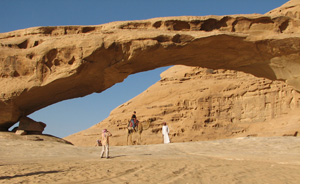 At our next stop we tumble out of the jeeps to squint against the sun at the oft-photographed Burdah rock bridge arching 35 metres above us. My companions waste little time clambering up the steep, rocky pathway to walk along the bridge while waving and posing jubilantly for my camera.
Our final stop in the Wadi Rum is at dusk, when the cool evening wind spins the sand into miniature dust-devils.
As the sun sinks to the horizon, the sandstone rocks around us are softened into pale mauve, and the desert is transformed into an enchanted fantasy world. The light is bronze, and the distant ranges become navy blue silhouettes against the enormous blood-orange orb now fast sliding out of sight. To my right a wild camel and its baby stand motionless against a rising full moon.
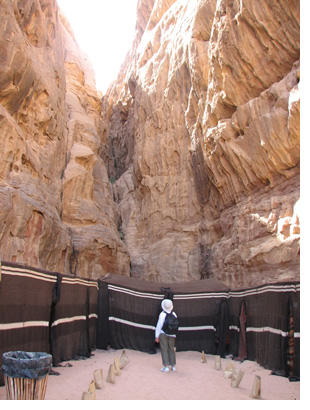 By the time we arrive at our Bedouin camp where we are to spend the night, the sky is a thicket of stars.
Brown canvas tents are arranged in a V with a heavy cloth curtain at each room’s entrance. My candle-lit room, with its double bed is partitioned from my neighbours’ tents by large hanging rugs. At the far side of the camp a row of flush toilets and shower stalls are an unexpected luxury.
Our Bedouin hosts welcome us with glasses of sweet tea followed later by dinner served under the desert sky. We nibble on hummus, baba ghanouj, khubez (roti) as appetizers and a main course Bedouin speciality, Mansaf —tender lamb seasoned with herbs and yoghurt.
A tin-foil moon rises high above our encampment, and we circle a leaping bonfire, dancing to the rhythm of a tabla (drum) and lute. When the flames sink into ashes, some of us, like our Bedouin hosts, sleep on bedding set out on benches in the open.
I wake early, a pale dawn gleaming through my tent curtain. In the breakfast buffet tent, a drop-dead handsome Bedouin pours me a cup of strong coffee. “Did you sleep well?” he asks, flashing a gently flirtatious, dimpled smile. I nod, wishing, not for the first time, that I was forty years younger…
But then, of course, I may never have left!
About the author:
This week Traveling Tales welcomes Margaret Deefholts, an author and freelance travel writer who lives in Surrey, a suburb of Vancouver B.C. Learn more about Margaret at her website www.margaretdeefholts-journeys.com
About the photos:
1: Exploring the vast Wadi Rum desert. Margaret Deefholts photo.
2: Burdah rock bridge. Margaret Deefholts photo.
3: Bedouin camp tents in the Wadi Rum. Margaret Deefholts photo.
For further information visit www.seejordan.org/
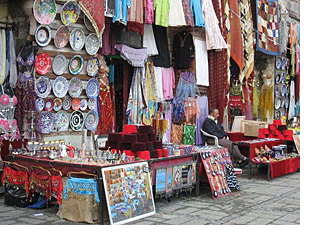
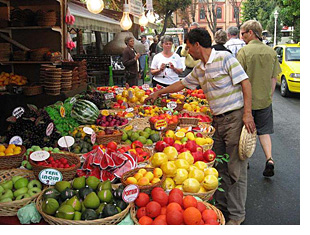
 Despite imaginings that I might be held up by a scimitar- wielding mugger, I thoroughly enjoyed my visit to this Aladdin’s Cave . No-one tried to rob me and the merchants were polite and entertaining. Sometimes we were offered tea poured into tulip-shaped glasses suspended on silver trays.
 Our shore excursion ended with lunch on the rooftop of the World Park Hotel. Here out of sight from most fasting Muslims, we were introduced to a variety of mezes, delicious hors d’oeuvres made of stuffed peppers, cucumber with yogurt, eggplant and humus.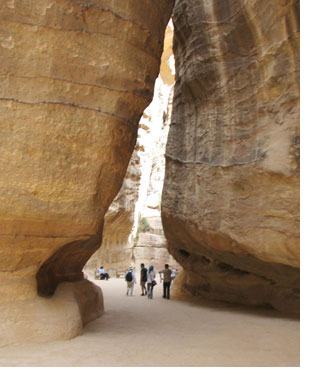
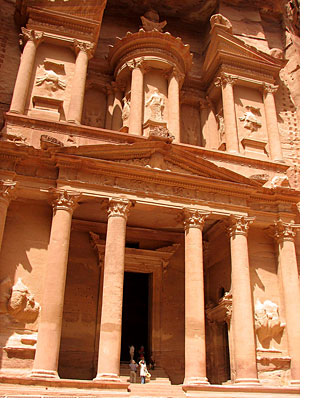 The canyon walls had fallen away suddenly, dramatically. Like curtains being drawn aside from a stage the famed Treasury of Petra stood revealed-in all its rose-hued glory. Although it is the most photographed sight in Petra, it came as a small shock to actually stand in front of it; to take in its enormous size and grandeur.
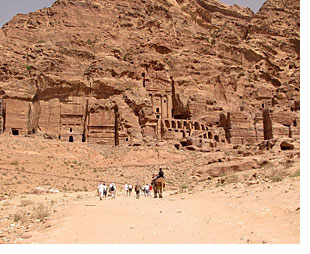 The ancient walled city sprawling over steep hillsides is enormous; far larger than I could cover in a day. The Street of Facades leading off the entrance square took me past a series of royal tombs.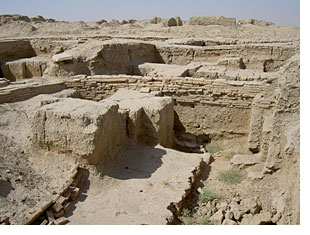
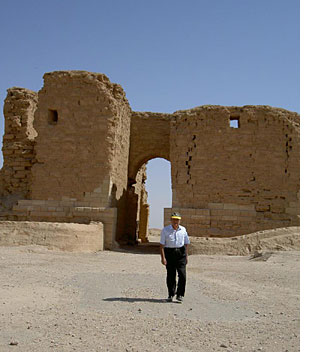 Climbing on to a desert plateau, we spotted the wind-worn walls of Doura Europos standing before us – at first sight impressive in their size. A fortified town overlooking the lush irrigated Euphrates Valley on one side and the empty desert on the other, it was once a very important economic and cultural centre in the Hellenistic, Roman, Persian and Palmyran periods.
 We entered the ruins in anticipation. Before us was a jigsaw puzzle of excavation sites. On a map at the edge of the covered Sacred Enclosure, we could make out some of the excavated spots. Nevertheless, it soon became apparent that, to get a true picture of Mari’s history, a guide was a dire necessity.
 A world of wonder is what you find at Turkey’s Black Sea. The region is rich in heritage, in sights, in culture – from stunning landscapes and natural wonders to World Heritage sites – here in all its ancient and mesmerizing glory. Standing on top of Al-Petri Mountain, one may wonder why such an iridescent blue sea is called the black sea. It’s thought that the name was given to it by sailors and pirates who were struck by its dark appearance when the sky turned leaden with storm clouds. Known by another name as well, the ancient Greeks called it the Scythian Sea as they plundered shipwrecks and made wine goblets from sailors’ skulls. Happily, on a recent visit I enjoyed my wine served in a pretty crystal glass as I gazed out over a perfect Blue sea. Reasons to make this your next go-to vacation spot are many. Here are just a few of them:
 How can we leave out Hamsi? This small fish is similar to the anchovy and in the region it is abundant. In fact, there are no less than forty different dishes made with hamsi, including desserts. Let’s just say it’s an acquired taste and leave it at that. More to my liking, there’s the Akcabat Kofte Hazelnut center in Ordu and in July, it hosts a Golden Hazelnut Festival.