by Mary Pat Musick
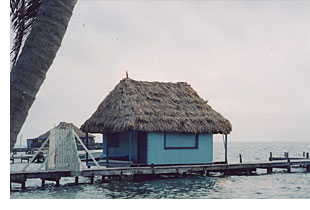 I stood on the balcony of our rented condo in San Pedro and watched the lone fisherman stroll to a small craft at the end of the tired-looking dock. He raised the sails, caught enough breeze to move through the still waters and sailed into a stream of an amber gold sunrise.
Seeing such a peaceful way to commute to work made me want to jump into the Caribbean and swim out to apprentice. I watched until he disappeared from view. That is how I started each day in Belize.
The first evening there, I took off my watch and set it on top of the refrigerator. It was the last time I wore a watch. On Ambergris Caye, where San Pedro is located, time is experienced in memories, not minutes.
Clinton, a local guide, that my husband and I hired, had a runabout with a motor that required daily maintenance so he came by on “Clinton-time” and took us with him on timeless adventures.
The longest barrier reef in the Western Hemisphere is off the coast of Belize, making it a popular dive and snorkel destination. So on days after Clinton patched up the boat’s motor, we snorkeled along the reef with schools of tropical fish.
He had fished, swam, and snorkeled in the waters off Ambergris Caye as long as he had memory. He knew the coral and the fishes and moved about the sea as if he rightfully belonged. We followed as his eager students.
On our first outing, the three of us went out to Shark Ray Alley, a part of a marine reserve about 4 miles south of San Pedro. For years fisherman used to clean their catch in the area and the nurse sharks and stingrays got used to finding an easy meal on the remains.
They still gather when a boat anchors and now seem to wait for guides to throw out chum as the animal’s reward for playing nice. The stingrays have wing-like fins that span up to 5 feet. I asked Clinton about the “sting” part. The only caution given was to neither step upon nor grab the ray’s tail. Instruction obeyed.
The creatures had gentle eyes and actually appeared to smile. After watching my husband and our guide swimming with their amiable playmates, I slid into the brilliant, warm, clear water. Gliding amongst several large rays, I felt like a sea goddess moving with them in a whimsical dream.
We found good fishing spots and followed the catch and release policy except for the fish we saved for dinner which we took ashore to an out-of-the-way beach where we gathered coconut shells to use as the fuel for cooking our fresh caught snapper. Of course it was delicious. The Caribbean and a beach we had mostly to ourselves are ingredients to make any meal magnificent.
The shore around San Pedro is an extraordinary place for water sports. All beaches are public. We were enchanted with this sea and found ourselves on it every day. Since the reef is only a half mile offshore, my husband and I got kayaks, which are available at a couple of docks along the beachfront, and paddled out to snorkel.
Other times, we rented catamarans from an outfitter and sailed north towards Mexico where there are remote resorts or along the southern coastline where the resorts are more plentiful. The reef protects the sea from large waves and makes for smooth sailing.
San Pedro is tourist-friendly and appears be able to handle it without surrendering it’s character.
Grass thatched roofs and short wooden structures mostly line the sandy roads. The town consists of only three streets. While there are laid back places that cater to divers as well as full luxury resorts, none are large mega hotels. The only access to town from the northern part is by boat or by crossing the San Pedro River, a channel that divides the island.
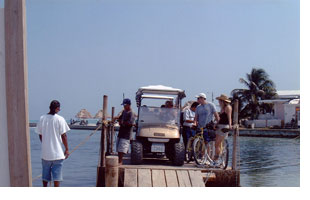 A pull-ferry carries passengers on the one-minute ride. Only pedestrians, bicycles and golf-carts, the main motorized means of getting around inland, can cross. The road on the northern side is a narrow unpaved path barely wide enough for two golf carts to squeeze by each other.
Even when we ventured inland to see the Mayan ruins at Lamanai it involved water transportation: first by a bumpy ocean boat to mainland Belize, then by van over roads that felt like we were surfing a tsunami, then finally by a riverboat ride though the jungle via the New River.
We watched for crocodiles as the captain told us, but spotted none. It was worth the wild ride from civilization to wander the excavated area of this ancient culture where archeologists are reclaiming temples and tombs and ball courts from the dense jungle vegetation.
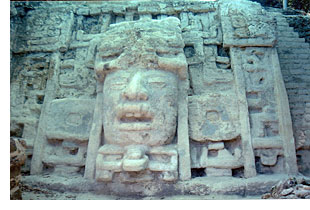 Viewing the size of the High Temple and the detail of the exposed mask on the Mask Temple helps one to understand that this was an important ceremonial site for the Mayans.
The aptly named black howler monkeys live in the jungle treetops and can be seen as well as heard. Lamanai had one of the longest Mayan occupation spans, from 1500 B.C. to 19th Century A.D.
One day in San Pedro, I walked down the sand road of the town to buy a pair of flip-flops. Even my sandals felt like too much baggage. A shopkeeper, where I hoped to make my purchase, had posted a sign: “Back Soon”. There is no hour called “soon”. If sandals felt like too much, then the Mavado on top of the refrigerator was clearly over the top.
I think about this laid-back place with its wonderful water playground and every once in awhile, I regret not swimming out to the lone fisherman.
About the author:
Traveling Tales welcomes freelance travel writer Mary Pat Musick who makes her home in Santa Cruz, California, USA.
Photos by Mary Pat Musick
1: Thatched roof on the boathouse.
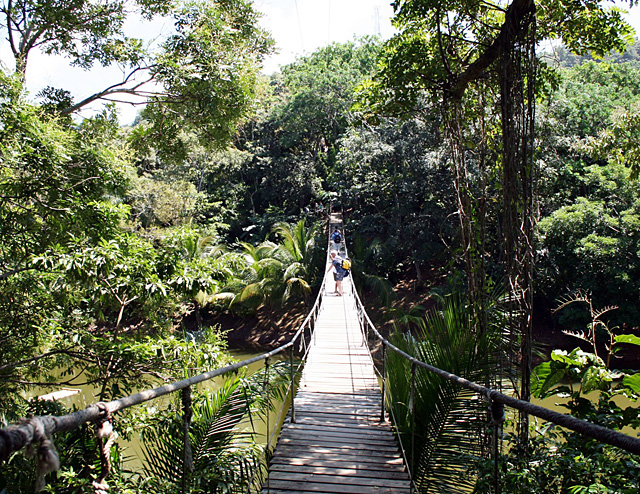
2: The pull ferry across the San Pedro River.
3: Mask on a temple in Lamanai.
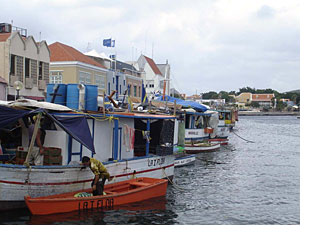
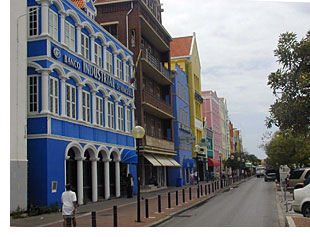 The architecture effortlessly blends its intriguing Dutch heritage along with an adornment of the Caribbean’s celebratory pastel shades. The people of Curacao are of Dutch, African, Spanish origins along with nearly every other race and nationality imaginable.
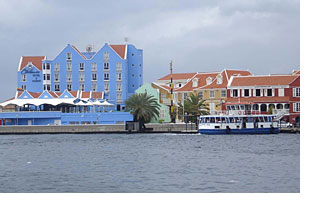 Looking across the bay, a quick ferry ride from Punda across the channel to Otrabanda transports you toward a long line of shopping stalls, old hotels and several wonderful restaurants. Look back and you’ll see the towering Queen Juliana Bridge, which allows the largest of ships to pass underneath to the oil refineries found back in the inner harbor, Schottegat. After oil was discovered at Lake Maracaibo in Venezuela in 1914, the Caribbean petroleum Company had decided to build a refinery on Curacao.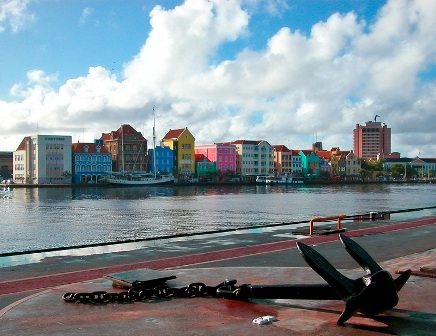
 After the swinging, hectic celebration of Queen’s Day, I awoke to the sound of the ocean softly beckoning outside my window. It was a call I had to answer, opting for a day of lazing on sparkling white sand of the iconic Avila Hotel and trying out my new snorkel gear. The water was warm as a bath and of a blue so luminous it defied description, making the view below a colorful romp with the myriad fishes that swim near the shore. Snorkeling is right up my particular alley – not scary, yet allowing me to feel I’m doing something really adventurous. However, for those of you who want to delve deeper, you should know that Curacao is a scuba diving paradise, among the best in the world with 165 dive locations, and a chance to view endangered coral reefs and ancient ship wrecks. That evening, we dined at Belle Terrace, Avila’s seaside restaurant, serenaded by a trio playing traditional island songs and sitting under a huge silver globe. Can that really be the moon? Yes, it was.
 Our stay at the Kura Hulanda Hotel was special. Our rooms were furnished with hand-carved mahogany and teak furniture and was surrounded by attractive bluestone walkways, boutiques, restaurants and sculpture gardens, all done in 18 th and 19 th century Dutch colonial style.
 Beneath a dense black ledge of clouds a full moon hoists itself above the horizon, revealing the best place to cross the swollen rivers. We can’t believe our luck. The downpour that has assailed us since dawn, has stopped just in time for our trek along this deserted beach. There are four of us following our guide, Jorge: myself, my partner David, and our close friends Heather and Eric. Jorge has gone on ahead and we’re to follow if and when he signals with his flashlight. Fringed by a jungle of palm trees on one side and the Pacific surf on the other, and intersected by numerous rivers, Ostinal Beach on Costa Rica’s Nicoya Peninsula is one of the world’s most famed “arribadas” beaches. Here, four to 10 times a year between July and November, Olive Ridley turtles trundle ashore by the thousands to lay upward of 80 eggs each before returning to the sea. Thirty-five to 40 kilograms in weight and 60 to 75 millimeters in length, an Olive Ridley may be one of the smallest of the world’s marine turtles, but it’s still plenty big enough to stub a toe on.
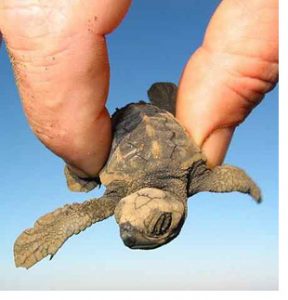 Observing one of these mass egg-laying phenomena has long been at the top of our must-do list, but we’ve been following Jorge for an hour and one thing is fast becoming clear: there will be no arribadas tonight.
 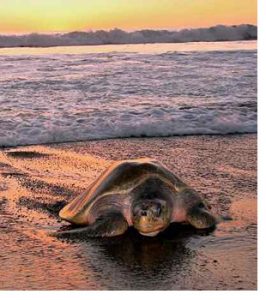 Across the bridge, no vehicle in sight. Nothing to do but splash on. Half an hour later, hope was revived when we saw a filthy pickup making its way toward us. In animated Spanish the driver explained everything, and we understood not a world. His final gesture was clear, however. Climb in. We did. After several bumpy miles the sight of yet another river slicing the road once again dampened our hopes. Our rescuer shrugged his shoulders and indicated the footbridge we could cross. He could go no further. On our own again. In a moment he had turned around and was heading back the way he had come, waving out the window. Again we found ourselves crossing an unexpected torrent, and squishing onward, but this time our soggy slogging was cut mercifully short. “Hurray, look!” Another pickup was bouncing toward us. Sloppy but enthusiastic greetings were shared all around, and then we were herded into the back of the driver’s open truck. A 15-minute dash through potholes and mud and we arrived at the village of Ostinal where a room in a hostel awaited us and our host pointed to his watch, indicating we would be turtle trekking at 10 p.m. As the four of us vowed to study Spanish more seriously next time, we gave thanks to the power of gestures and to the Gods who had allowed us to bumble on this far.
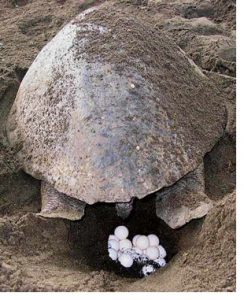 The four of us hug each other. The howler monkeys are back, roaring in the trees, but they no longer sound ominous. The universe has tipped toward us, and we can’t believe we are here at last; two hypothermic couples with a pathetic smattering of Spanish and a non-English-speaking guide, yet we understand. We understand we are blessed. For two hours, while the moon spills its light and we stand entranced, the valiant Ridley first pushes her eggs into the deep, funnel-like hole she has scooped out then covers her eggs with sand. Crying from exhaustion, the Ridley now begins to rock, but this is no lullaby. She’s gathering momentum for gigantic slams over the covered eggs, packing the disturbed sand solidly to protect her ‘nest’ from scavengers. These baby turtles will hatch without the comfort of their mother.

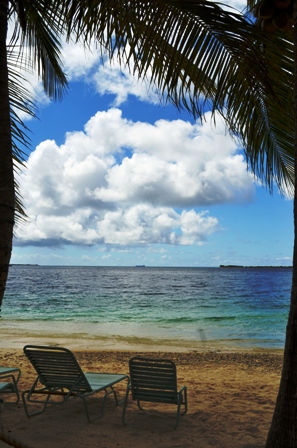




 The tiny Dutch island of Curacao in the Caribbean, seems an unlikely spot for an anthropological dig. Not the kind where the dusty soil coats to the sweat of your skin and creeps beneath your finger nails but the sort where human history is revealed up close and personal by simply keeping your eyes open.
 While the Spanish were the first to lay claim to Curacao in 1499, by the mid 1600s it had become a strategic and bountiful Dutch colony. Apart from a couple of brief British interruptions in 1803 and 1807-1816, it has remained an autonomous part of the Netherlands ever since, with a lucrative plantation system, and a busy commercial harbor which once operated one of the largest slave-trading depots in the Caribbean.
 There is a strong Jewish community (settlers began arriving here to escape the Spanish and Portuguese Inquisitions) and the Mikve Isreal Emanual Synagogue, built in 1732, is the oldest synagogue in continuous operation in the Western Hemisphere.
 If time of the essence, then a visit to Kura Hulanda is a must. This is where slaves were first deposited before heading on to the ‘new world’ and so, for islanders, carries a dark history. Kura Hulanda not only acknowledges this heritage, it has become a fascinating historic and environmental preservation project that comprises refurbished homes as guest accommodations, airy restaurants, gardens and a museum housing the largest collection of African artifacts in the Caribbean. It even has a recreated full-size slave ship’s hold that demonstrates the appalling circumstances under which slaves were shipped. Visiting Kura Hulanda is a rich and textured travel experience.
 If time has languished into a Caribbean rhythm, be sure to include a visit to Den Paradera. This is the 100-acre home-garden of Dinah Veeris, a spiritual and holistic herb doctor whose mission is to teach ‘the old ways’ to the younger generation. As such, she mixes hands-on exhibits and education with folklore, inviting you to crush leaves, taste petals and learn of a plant’s curative properties. If the leaf sprouts roots, the love is true; if not, move on to another suitor. Her shop, too, is a veritable apothecary of herbal remedies and solutions for any number of ailments, many of which she’ll diagnose a remedy.